
Our Story: From Luke's 2020 Diagnosis to $6.1 Million in Research
Stories of Hope
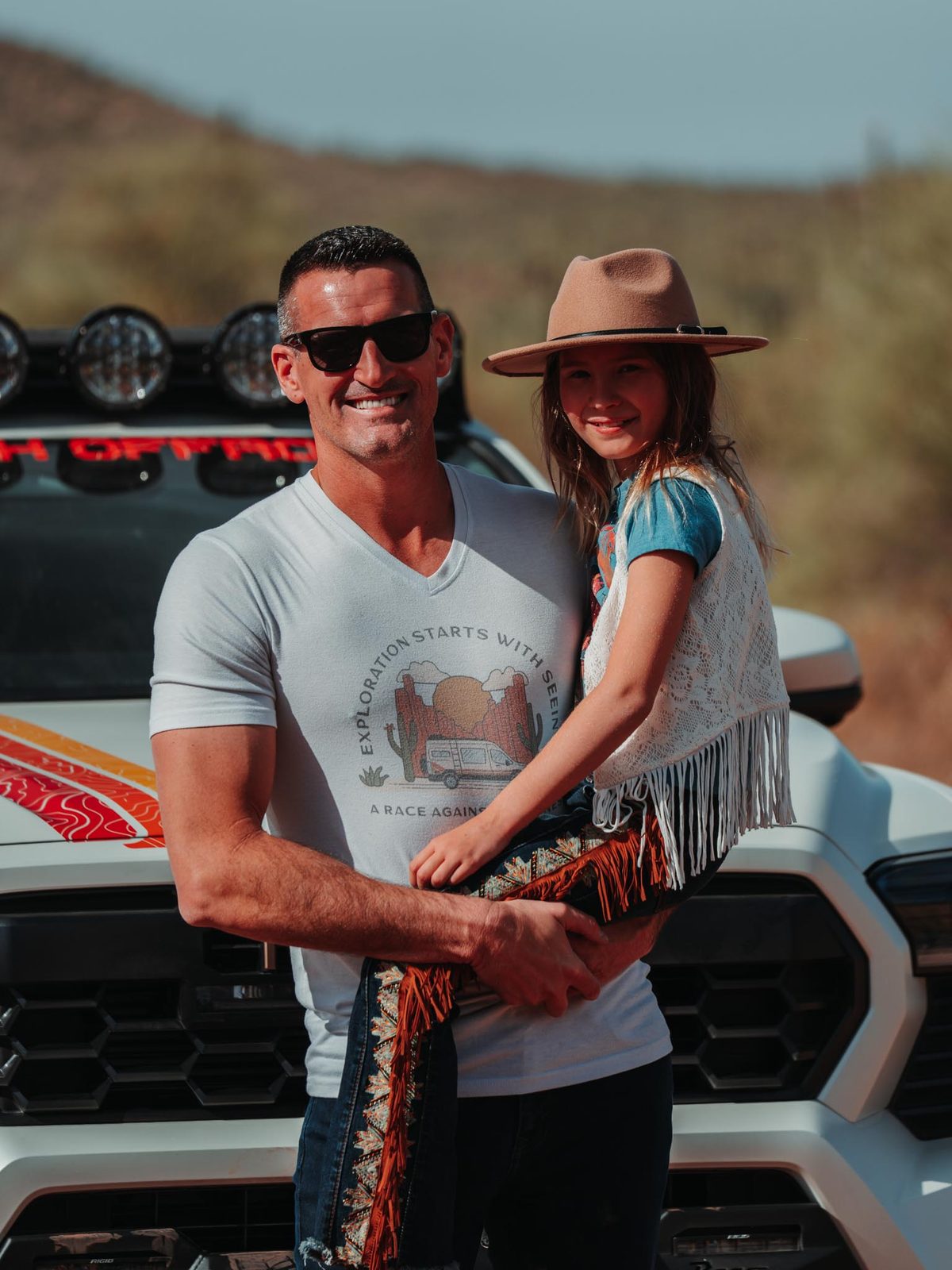
A Race Against Blindness started in 2020 with a diagnosis and a sentence: our son Luke has Bardet-Biedl syndrome, and there is nothing you can do. We did not accept the second half. Six years later the nonprofit we founded has paid out $6.1 million in research grants, funded the first gene-therapy clinical trial for the condition, and built a free education hub for families facing any inherited retinal disease. This is how that happened, told by the people it happened to.
2020: the diagnosis
In 2020 our son Luke was diagnosed with Bardet-Biedl syndrome. BBS is a rare genetic condition that affects several body systems, and in the eye it causes retinitis pigmentosa: the light-sensing cells of the retina die off over years, night vision goes first, then peripheral vision, and for most children the loss is well advanced by their teens. There is no approved treatment. We were told there was nothing we could do about it.
Kristina is a nurse and I am a physician, and neither of us had heard of the condition before that appointment. That turned out to be the normal experience. BBS affects roughly one child in 100,000 in North America, so most pediatricians will never see a case, most families spend years getting to a diagnosis, and the research that could change the outcome is funded by almost no one, because almost no one knows it exists.
As parents, that was a heart-wrenching diagnosis. We felt hopeless and helpless at the same time. The thing about hopeless, though, is that it is a conclusion, and the evidence for it was thin. Gene therapy for inherited retinal disease was no longer science fiction: the first one had been approved by the FDA in 2017 for a different gene. What stood between Luke's gene and a trial was not a scientific wall. It was money, and the attention money follows.
Why "a race"
The race has never been against other people. It is against a clock inside Luke's eyes, and inside the eyes of every child with an inherited retinal disease: gene therapy can only protect the retinal cells that are still alive, so every year a treatment is delayed is a year of vision that cannot be given back. That clock explains most of what people notice about us, including why we fundraise the way we do and why we never seem to slow down.
In April 2026 I rode El Tour de Zona, a multi-day ride through Southern Arizona, back where this started. By then the organization that El Tour had introduced as a family navigating something unexpected had funded more than $5 million toward a gene therapy trial. The ride was not a race either. It was a way of saying thank you to a community that showed up before there was any proof we could do this.
2023: a nonprofit, a mailbox and a van
The IRS recognized A Race Against Blindness as a 501(c)(3) public charity in February 2023 (EIN 92-2174042). Kristina and I founded it; Shelley Kramer, Luke's grandmother, is the treasurer, and her husband Dan sits on the board. Our address is a mailbox in Gilbert, Arizona. We have never rented an office and do not intend to; every dollar spent on a lobby is a dollar not spent on a trial.
That first year I funded the organization's costs myself, and I donated its first prize: a new custom adventure van built by 27North, worth about $250,000, which I had bought for our family. It became the grand prize of our very first sweepstakes fundraiser. Without that van there would have been no first fundraiser, and without a first fundraiser there would have been no evidence that a family nobody had heard of could raise research money this way.
The evidence came fast. By the end of 2024 the fundraisers that followed that van had paid for $3 million in research grants, and the organization that started with one vehicle in a driveway had a Candid Platinum Seal of Transparency and a feature on Good Morning America.
Why sweepstakes instead of galas
Because a gala raises money from the people in the room, and the people in the room already know about BBS. Rare-disease research needs money from people who have never heard of the disease, and the only way to reach them at scale is to offer something they already want. A van, a truck, a six-figure cash prize: those are tools. They put Luke's story in front of millions of people who would never have searched for it, and a meaningful share of those people choose to donate once they understand what the money does.
We built the model to survive scrutiny, because we knew large prizes would invite it. Every fundraiser is a sweepstakes with its own Official Rules; anyone eligible can enter for a chance to win free by mail. An independent administrator, American Sweepstakes & Promotion Co., Inc., conducts every drawing and confirms every winner. We announce winners live and list every one on our Past Winners page. And the money is accounted for in public: two annual reports, a Form 990 anyone can read on ProPublica, and more than 17,700 Trustpilot reviews we do not control.
It is an unusual way to run a children's medical charity. It is also, as far as we can tell, the fastest one.
2024 to 2026: from the first million to a funded trial
In October 2024 we made our first grant: $1 million to Axovia Therapeutics, the company developing AXV-101, a gene therapy for the BBS1 form of the condition, which is Luke's. We knew we had to do something, not just for Luke, but for every family facing a rare disease diagnosis, and this was the first thing that looked like doing it. Two months later came $2 million more for manufacturing and safety studies. In September 2025, $1 million for the work needed to get the trial authorized; in December 2025 the UK regulator, the MHRA, approved it. In January 2026 a final $1.1 million fully funded the trial. Five point one million dollars, from fundraisers, in fifteen months, and a treatment that did not have a path to patients now has one.
We began this journey to help our son, but it has grown into something far bigger. In May 2026 we funded the Bardet-Biedl Syndrome annual conference, covering patient travel and every session's media so families anywhere in the world could watch. In June 2026 we paid $1 million, matched to $1.55 million, to Foundation Fighting Blindness and the RD Fund for gene-agnostic therapies: approaches that could work across many inherited retinal diseases at once, not only BBS. And in August 2026 we opened a Research Grants Program with published priorities and evaluation criteria, so the next grants are chosen in the open rather than at our kitchen table.
The total, as of October 2026, is $6.1 million, all of it paid, none of it pledged. The dated list is on our grant history.
Where the race stands now
The mission is wider than it was in 2020 and the clock is the same. We fund research toward treatments for Bardet-Biedl syndrome and the whole family of inherited retinal diseases that cause childhood blindness, with a preference for work that gets a therapy into a clinical trial rather than into a journal. We advocate for the rare and ultra-rare disease communities, which are too small to be heard one at a time. And in 2026 we built the IRD Education Hub, a free resource covering 53 conditions, 125 genes, every active clinical trial and the specialists who treat them, because the hardest part of our own diagnosis was not the news but the silence that followed it.
Luke is a teenager now. He is kind, reserved, more resilient than a child should have to be, and he would rather talk about his pets than about any of this. The first gene therapy for his condition is in a clinical trial because tens of thousands of people who never met him entered a fundraiser and chose to donate. If you are one of them, this is your story too. If you are a family who just heard the sentence we heard in 2020, start at the Education Hub, then reach us. We were told there was nothing we could do. There was.
Frequently asked questions
Who founded A Race Against Blindness?
Dr. Stephen Johnston, a physician, and Kristina Johnston, a registered nurse, founded A Race Against Blindness after their son Luke was diagnosed with Bardet-Biedl syndrome in 2020. The IRS recognized it as a 501(c)(3) in February 2023.
What is Bardet-Biedl syndrome?
A rare genetic condition that affects several body systems and causes retinitis pigmentosa, a progressive loss of the retina's light-sensing cells that leads to blindness. It affects roughly one in 100,000 children in North America and has no approved treatment.
Where is A Race Against Blindness based?
Gilbert, Arizona. The organization uses a mailbox rather than an office so that overhead stays low.
How much research has A Race Against Blindness funded?
$6.1 million as of October 2026, fully paid out: $5.1 million to Axovia Therapeutics for the AXV-101 gene-therapy clinical trial for BBS1, $1 million to Foundation Fighting Blindness and the RD Fund for gene-agnostic therapies, and support for the BBS annual conference.
Do the founders get paid?
Stephen Johnston drew no salary in 2023, 2024 or 2025, personally funded the organization in 2023 and donated its first prize. Officer compensation is reported on the public Form 990.
How does the organization raise money?
Through sweepstakes-style fundraisers with free mail-in entry, an independent administrator who draws the winners, and public winner announcements. Most participants choose to donate, and donations fund the research grants.
No purchase or donation necessary. Void where prohibited. See Official Rules for details.