
What does choroideremia look like?
What your son sees as the patches grow. In the words of people who live with it, with the frames from our simulator and the sources behind every statement.

The short answer
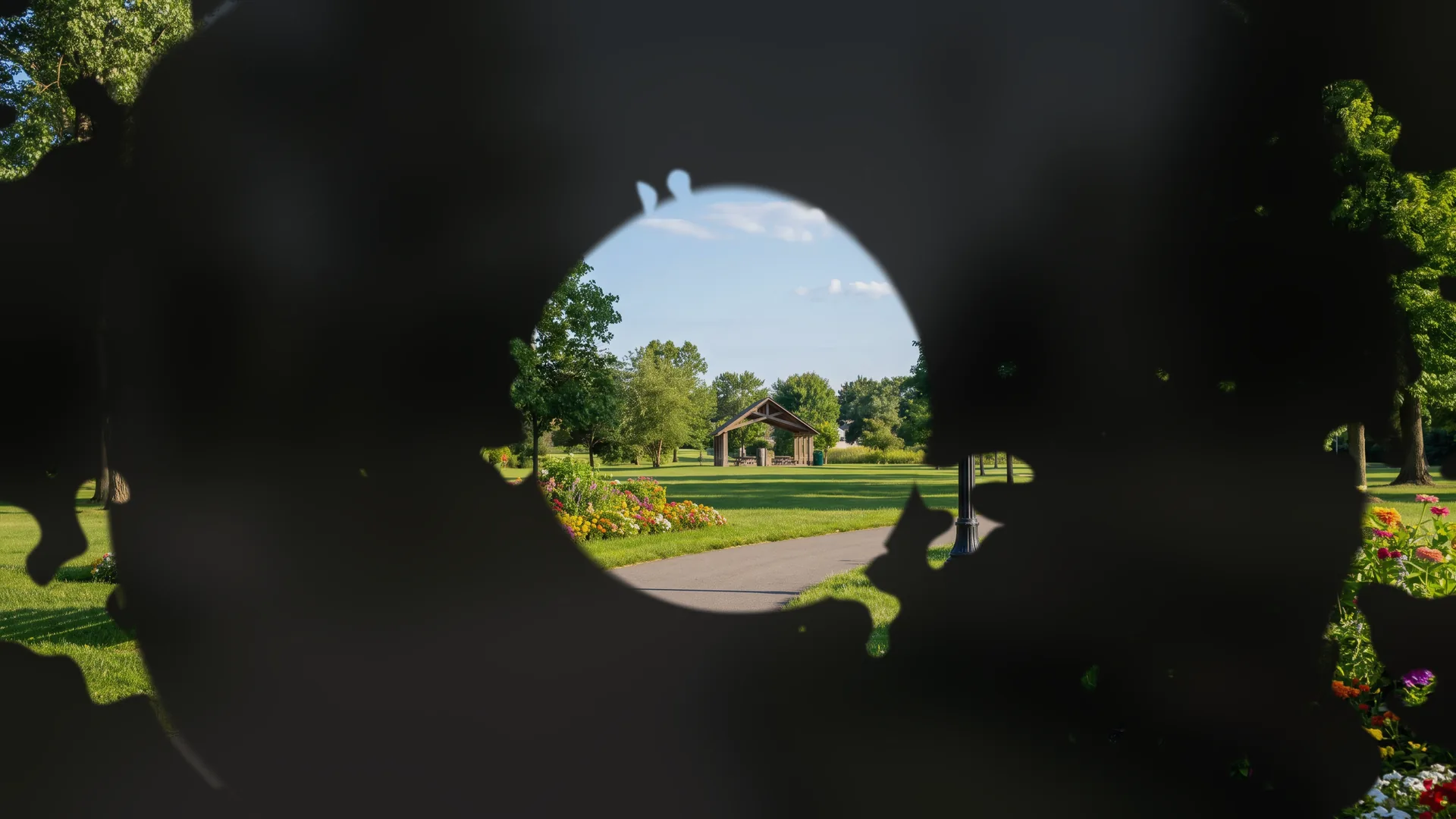
A boy with choroideremia sees the world in three phases. First, from childhood, the dark is hard: dim rooms and dusk give him trouble while daytime looks normal. Then, from the teens or twenties, pieces of his side vision go missing in sharp-edged patches that slowly join into a ring around a clear center. Finally, usually decades later, the clear center shrinks to a tunnel. Throughout, what is lost is not black; it is simply absent. Central sharpness is usually kept until middle age or later.
- What the person is experiencingChoroideremia (CHM) mainly affects boys and men and is caused by changes in a single gene on the X chromosome, passed down through mothers who are usually unaffected carriers.
- Why the patches have hard edgesChoroideremia looks different from retinitis pigmentosa, and the difference matters for how it feels.
- In their wordsPublished first-person accounts specific to choroideremia are scarce, and we have not quoted any here; the patient organizations describe the experience in general terms.
See it, stage by stage
The left view never changes. The right one is the same park as choroideremia shows it, drawn from the research our simulator rests on. Pick a stage; the caption tells you what each frame shows and what it cannot.
Mid
A scalloped ring of patches that has joined up around a clear center, with the lost areas drawn as absence rather than black.
Watch choroideremia progress
What the person is experiencing
Choroideremia (CHM) mainly affects boys and men and is caused by changes in a single gene on the X chromosome, passed down through mothers who are usually unaffected carriers 1. The first symptom is usually night blindness, which often appears in childhood or early adulthood 2. This is followed by loss of vision in the mid-periphery, which can begin in the late teens or twenties 2. Doctors describe these blind spots as forming "an irregular ring, leaving only patches of peripheral vision while central vision remains intact", and the loss then spreads in both directions, eventually leading to tunnel vision in the thirties or forties 2.
Central vision is spared for a long time. Good sharpness is generally kept until the fifth to seventh decade, though color vision can fade before sharpness does 1. Even in advanced disease, small islands of vision can remain at the very center and light can still be seen far out to the sides 1. Other changes can include reduced sharpness, poorer depth perception that makes distances harder to judge, color changes, more glare, and worsening night blindness 2.
Why the patches have hard edges
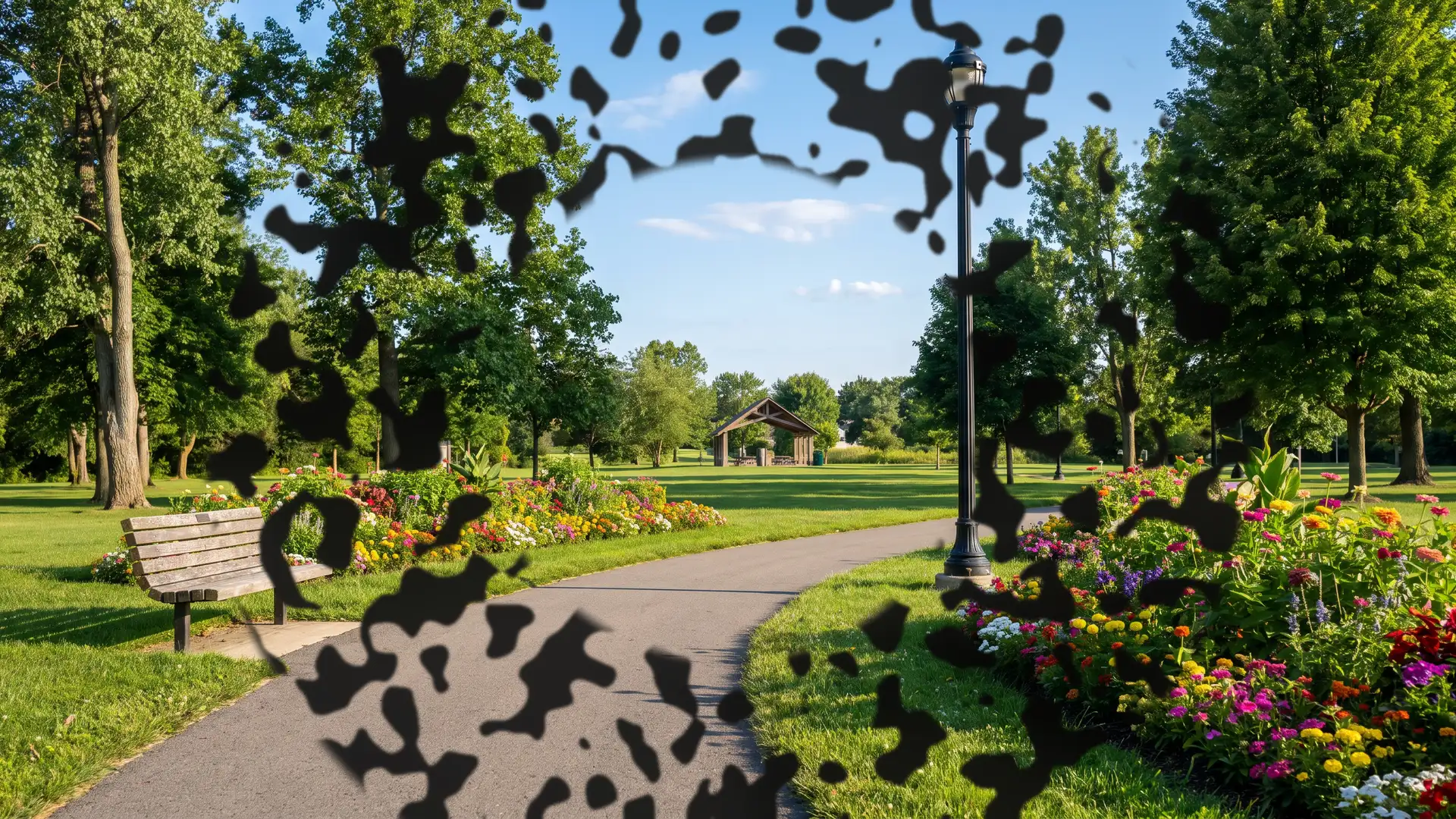
Choroideremia looks different from retinitis pigmentosa, and the difference matters for how it feels. In RP the edges of the lost field are gradual. In choroideremia the retina is lost in sharply bounded patches, and researchers who tested vision right at the edge of these patches found that sight drops off abruptly: full sensitivity on one side and a dense blind area on the other, over a distance smaller than a standard test spot 3. For your son this means a face or a cup can be fully visible and then, with a small movement of the eyes, partly gone. Because the patches sit in the mid-periphery, not the center, he usually does not notice them directly; what he notices is that things appear "from nowhere" on one side.
In their words
Published first-person accounts specific to choroideremia are scarce, and we have not quoted any here; the patient organizations describe the experience in general terms. The Choroideremia Research Foundation describes vision "leading to tunnel vision" and a "washed-out appearance" in later stages 4. The pattern of night blindness followed by side-vision loss is shared with RP, so the RP accounts on this site apply: not noticing the early loss, the brain filling in the gaps, and objects that pop up unseen from the side 5 6 7.
What our simulation shows
The hard edges on the patches are deliberate and come from the edge study above 3.
Signs you might notice in a boy
- Trouble at dusk, in cinemas and in dark hallways from an early age, with normal daytime vision 2 9.
- Bumping into things on one side, or missing a ball that comes from one direction, before he reports anything wrong 10 11.
- Misjudging distances, for example on steps or when reaching 2.
- A mother or sister with mild night blindness, which carriers can have 1.
Common questions
Will he go blind?
Choroideremia is progressive and can ultimately lead to very severe loss, but the rate varies between individuals, severe impairment commonly occurs in late adulthood, and some people keep useful vision well into later life 12 2. Even late in the disease, central islands and far-peripheral light perception often remain 1.
Is it the same as RP?
What helps right now?
Lighting on stairs and hallways, a flashlight, telling teachers and coaches which side is weaker, and genetic confirmation, which is what opens the door to clinical trials 1.
Go deeper
- The choroideremia profileGenes, inheritance, what to expect, and what is in trials.
- For the clinician in the familyNot yet live. The clinician page for this condition is still in review.
- What the other conditions look like
- What does night blindness look like?
- What does retinitis pigmentosa look like?
- What does Stargardt disease look like?
- What does cone dystrophy look like?
- What does achromatopsia look like?
- What does Best disease look like?
- What does Usher syndrome look like?
- What does Leber congenital amaurosis look like?
- What does vision loss look like in Bardet-Biedl syndrome?
- Children and familiesSchool, services and support, with early warning signs by age.
References
Sources were read on Oct 22-23, 2026.
- 1.American Academy of Ophthalmology, EyeWiki. Choroideremia. https://eyewiki.aao.org/Choroideremia
- 2.Choroideremia Research Foundation (CureCHM). Symptoms and Progression. https://curechm.org/symptoms-progression/
- 3.Tuten WS, Vergilio GK, Young GJ, Bennett J, Maguire AM, Aleman TS, et al. Visual function at the atrophic border in choroideremia assessed with adaptive optics microperimetry. Ophthalmol Retina. 2019;3(10):888-899. doi:10.1016/j.oret.2019.05.002 https://pmc.ncbi.nlm.nih.gov/articles/PMC6778501/
- 4.Choroideremia Research Foundation (CureCHM). What is Choroideremia. https://www.curechm.org/what-is-choroideremia/
- 5.GeneReviews [Internet]. Nonsyndromic Retinitis Pigmentosa Overview. University of Washington, Seattle. https://www.ncbi.nlm.nih.gov/books/NBK1417/
- 6.Hadley. Hadley Presents: The Blind Poet, Dave Steele (podcast transcript; Dave Steele describing retinitis pigmentosa). https://hadleyhelps.org/podcasts/hadley-presents/blind-poet-dave-steele
- 7.Lawson Visconti L. Going blind in a sighted world (personal blog; first-person account of retinitis pigmentosa). http://lauralawsonvisconti.com/blog/rp
- 8.A Race Against Blindness. How our vision simulations were built: research basis and rendering conventions (Education Hub, Oct 2026). https://araceagainstblindness.org/education/vision-simulations/methodology
- 9.Nemours KidsHealth. Retinitis Pigmentosa (for Parents). https://kidshealth.org/en/parents/retinitis-pigmentosa.html
- 10.Gene Vision (UK). Retinitis pigmentosa: for patients. https://gene.vision/knowledge-base/retinitis-pigmentosa-for-patients/
- 11.A Race Against Blindness. Children and Families Guide: Early Warning Signs by Age. https://araceagainstblindness.org/education/children-and-families
- 12.Retina UK. Choroideremia. https://retinauk.org.uk/information-and-support/about-inherited-sight-loss/types-of-inherited-sight-loss/choroideremia/
About this page
This page is an additional resource for the community. It is not a substitute for advice from your own eye care team, or for medical journals, textbooks or clinical training. We have done our best to provide accurate and up-to-date information, and the references are listed above, but inaccuracies and omissions may exist. Confirm any medical information with your eye care team or against primary-source medical education resources before relying on it. The simulation frames are approximations built from the cited literature, not a prediction of anyone's vision.