
What does Stargardt disease look like?

Seeing the world through your child's eyes. In the words of people who live with it, with the frames from our simulator and the sources behind every statement.
Medically reviewed by Stephen Johnston, MD. Reviewed 2026-10-23.
The short answer
A child with Stargardt disease sees the edges of the world normally and the middle poorly. Whatever they look straight at is blurred, distorted, or simply not there, while everything around it is sharp. The missing center is not a black hole; the brain fills it in with whatever color and texture surrounds it, so the child may not even know it is there. That is why your child walks through a crowded room easily but cannot read the board, recognize a friend across the playground, or find a face in a photo.
What the person is experiencing
Stargardt disease affects the macula, the small central part of the retina used for fine detail, reading and recognizing faces. The result is a slow, painless loss of central vision in both eyes, which can be blurry, distorted, or have dark areas. Side vision is usually not affected, and most people keep good side vision for life. Early on, people may have good vision yet notice difficulty reading, trouble seeing in dim light, blurriness and distortion, and slow adjustment between bright and dark. Many people find bright light uncomfortable.
How much sharpness goes varies a great deal: at diagnosis vision ranges from 20/20 to 20/400. The pace varies too, even within a family, so it is very difficult to predict what an individual's vision will be at a given time.
Why the blind spot is not black
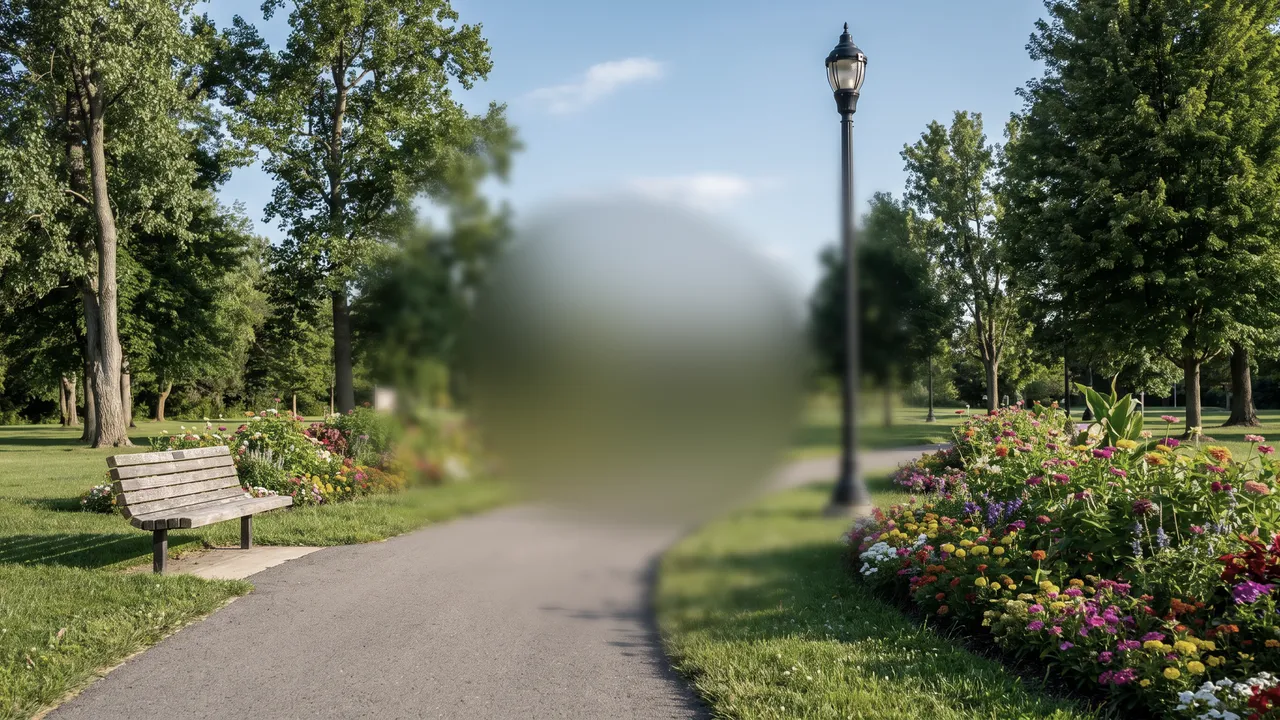
This is the hardest thing to picture, so it is worth being precise. Researchers studied people who had blind spots in the center of both eyes and asked what they saw there. All of them described the missing area as a blank patch the same color and brightness as the background, and none saw anything inside it; the brain fills the gap with the surroundings. Because of this, many people with central blind spots are not fully aware of them. If your daughter looks at your face and your nose is missing, she does not see a hole where your nose was. She sees skin, filled in, and a face that is strangely hard to recognize.
In their words
Children with Stargardt disease tend to describe the effect, not the picture. Dylan, a student in a film about living with the disease, says of the classroom: "if I don't use my machine, my cctv, to see the board, I can't. It all just looks like a blur and I can't see nothing". Kristal was diagnosed in third grade after her teacher told her parents "that she had cried in class because she had trouble seeing the blackboard"; at the eye test, her mother recalls, "all she could see was the big E". Meaghan, diagnosed at 20/50 and later 20/200, says simply: "The toughest thing about having Stargardts is that you can't see exactly everything that everybody else can see".
In interviews with 21 patients and 7 parents, the most cited symptoms were light sensitivity and declining central vision, and the social impacts included difficulty recognizing faces. Not recognizing people is one of the most misunderstood parts of the condition; it can look like rudeness and is actually a blank where the face should be.
"If I don't use my machine, my cctv, to see the board, I can't. It all just looks like a blur and I can't see nothing." Dylan, a student in a film about living with the disease, says of the classroom, American Macular Degeneration Foundation.
How children work around it
Children learn to look slightly to one side of what they want to see, using the healthy retina around the damaged center. This is called eccentric viewing and can make a big difference. It is why a child with Stargardt disease may seem not to be looking at you when they are, in fact, looking at you as well as they can. They also sit close, choose large print, enlarge text on screens and move nearer the television.
What our simulation shows
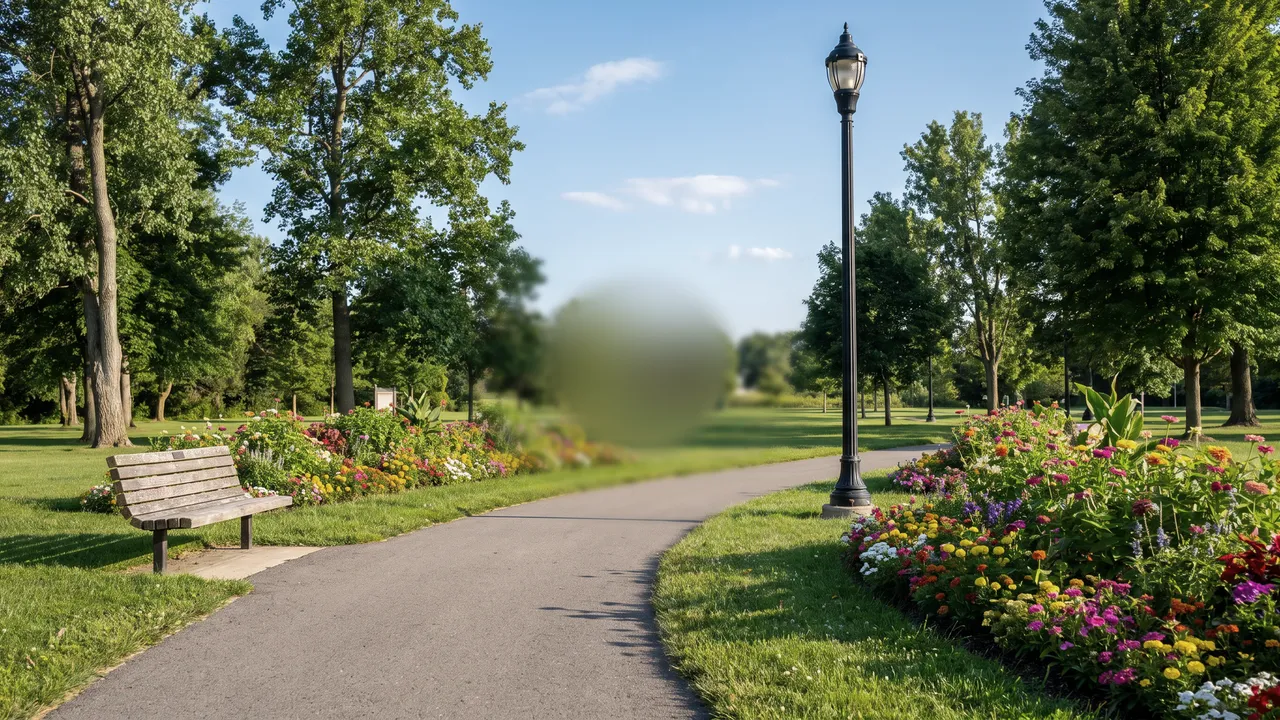
Look at the main frame and notice how easy it is to miss the blind area: that is the point. In real life the blank moves with the eyes, so it is always exactly where the child is trying to look.
Early: Only a soft blur and slight waviness at the center.
Mid: A filled-in blind area about 10 degrees across, matching the commonest pattern doctors describe, with the surroundings still sharp.
Late: This frame widens the blind area and adds color loss.
Signs you might notice in a child
Crying or frustration over the board, small print or homework, before anyone suspects the eyes.
Sitting very close to screens and holding books near the face.
Looking slightly past things or turning the head to see.
Not recognizing familiar people until they speak, and squinting or discomfort in bright light.
No trouble at all running, climbing or finding the way around, which can make the reading problem seem like a behavior problem.
Common questions
Is she going to be completely blind?
In most cases people with Stargardt disease do not lose all their sight; it usually affects central vision only and side vision is not usually affected.
Why does she see better at the sides?
Because the disease is in the macula and the surrounding retina keeps working.
Why is she worse in bright light?
Light sensitivity is one of the most reported symptoms, and bright light is uncomfortable for many people. Good sunglasses in direct sun are also recommended to help protect the retina.
What helps right now?
Large print, enlarged text on devices, sitting close, a CCTV or magnifier at school, sunglasses and a brimmed hat outdoors, and learning eccentric viewing with a low-vision specialist.
References
Sources were read on Oct 22-23, 2026.
1. Macular Society (UK). Stargardt disease. https://www.macularsociety.org/macular-disease/macular-conditions/stargardt-disease/
2. Tripathy K, Kaur K. Stargardt Disease. In: StatPearls [Internet]. StatPearls Publishing; updated 2024. https://www.ncbi.nlm.nih.gov/books/NBK587351/
3. American Academy of Ophthalmology, EyeSmart. Stargardt disease symptoms. https://www.aao.org/salud-ocular/consejos/stargardt-disease-symptoms
4. Retina UK. Stargardt disease. https://retinauk.org.uk/information-and-support/about-inherited-sight-loss/types-of-inherited-sight-loss/stargardt-disease/
5. Pratt JD, Stevenson SB, Bedell HE. Scotoma visibility and reading rate with bilateral central scotomas. Optom Vis Sci. 2017;94(3):279-289. doi:10.1097/OPX.0000000000001042 https://pmc.ncbi.nlm.nih.gov/articles/PMC5321850/
6. American Macular Degeneration Foundation. Living with Stargardt Disease (video transcript; Meaghan, Dylan, Kristal and their parents). https://www.macular.org/resources/video-presentations/living-stargardt-disease
7. Living with Stargardt disease: insights from patients and their parents (qualitative interview study, 21 patients and 7 parents, US and France). PubMed PMID 33305649; 2020. https://pubmed.ncbi.nlm.nih.gov/33305649/
8. A Race Against Blindness. How our vision simulations were built: research basis and rendering conventions (Education Hub, Oct 2026). https://araceagainstblindness.org/education/vision-simulations/methodology
9. Raising Children Network (Australia). Low vision and blindness: babies, children and teenagers. https://raisingchildren.net.au/disability/guide-to-disabilities/assessment-diagnosis/low-vision-blindness-babies-children-teens