
What does retinitis pigmentosa look like?
What your child with RP actually sees. In the words of people who live with it, with the frames from our simulator and the sources behind every statement.

The short answer
In daylight, early retinitis pigmentosa (RP) usually looks normal to the person who has it. What is missing shows up first at dusk and in dark rooms, and later as things that simply are not there at the sides: a ball, a waiter, a dog on the floor. The lost areas are not black. People with RP describe them as nothing at all, the way you do not "see" what is behind your head. This article walks through those three ideas, in the words of people who live with RP, and explains what our simulation frames are trying to show.
- It starts with the dark, not the sidesThe first symptom of RP is usually trouble adapting to the dark, and if a person does not mention it, careful questions about dusk and dimly lit places often bring out a history that goes back to childhood or the teenage years.
- Why your child does not notice the side vision goingThis is the part families find hardest to believe.
- What tunnel vision actually looks likeOver years the ring of blind spots widens outward and inward until a small central area remains, which is the "tunnel" people talk about.
See it, stage by stage
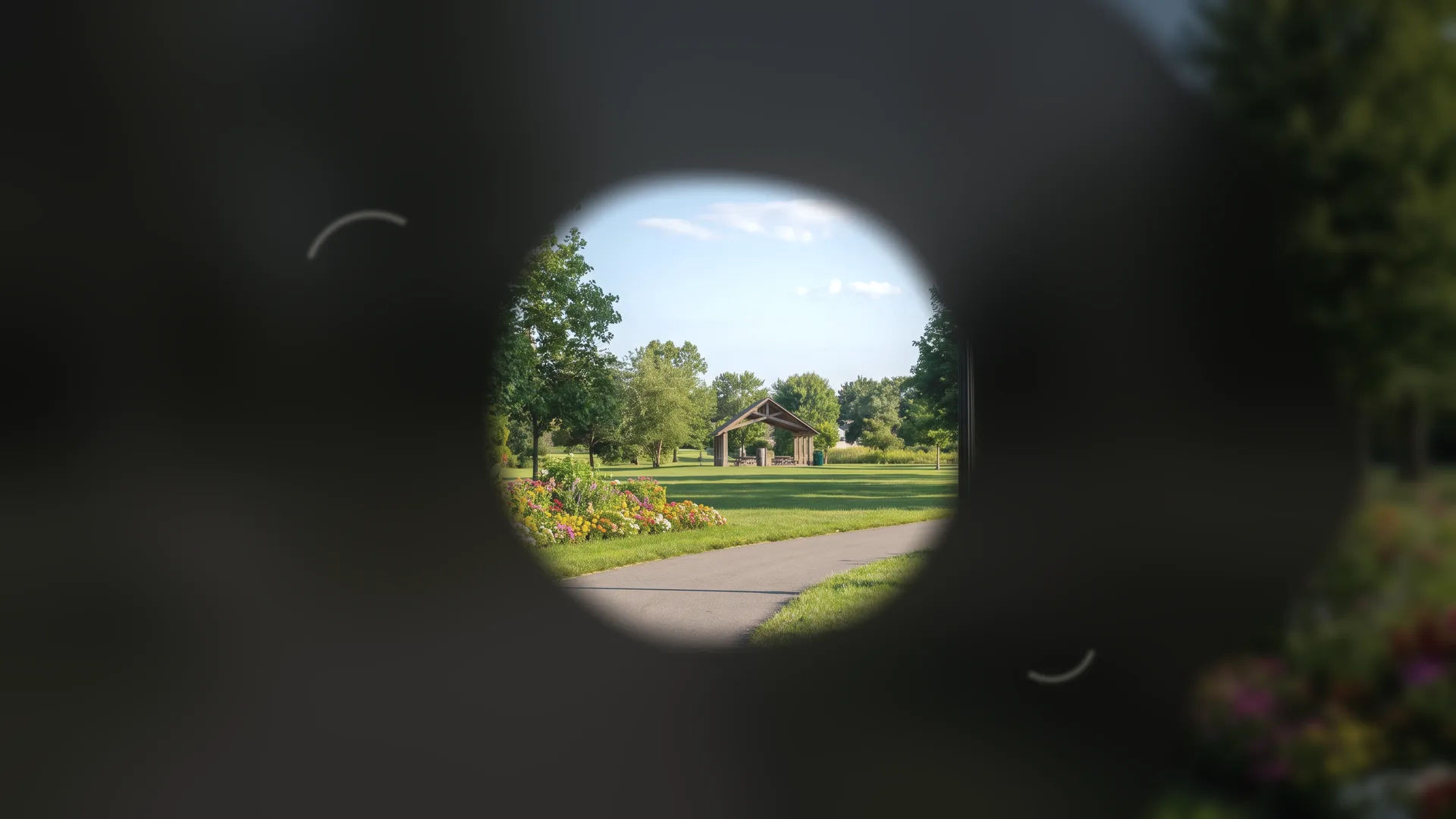
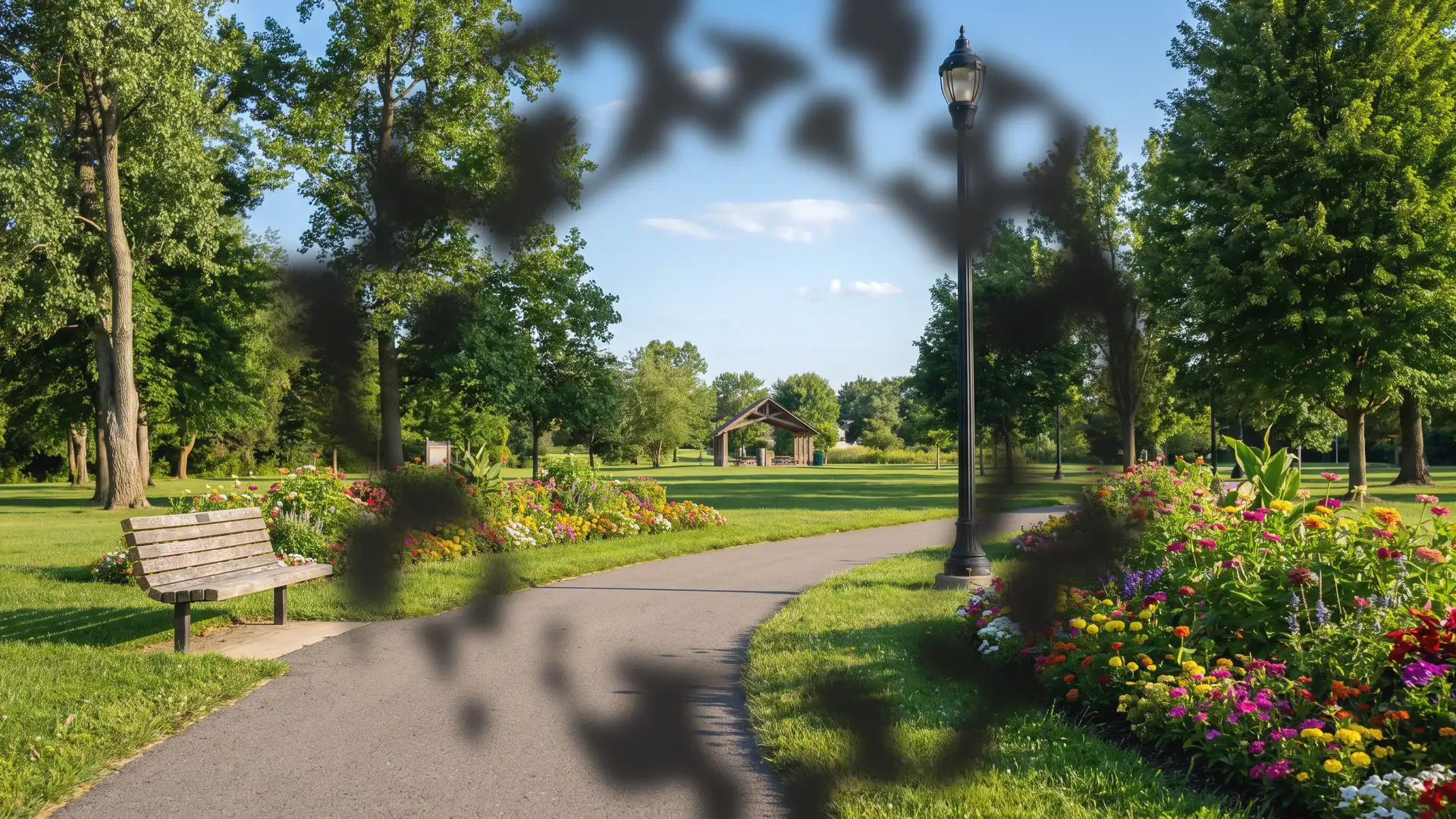
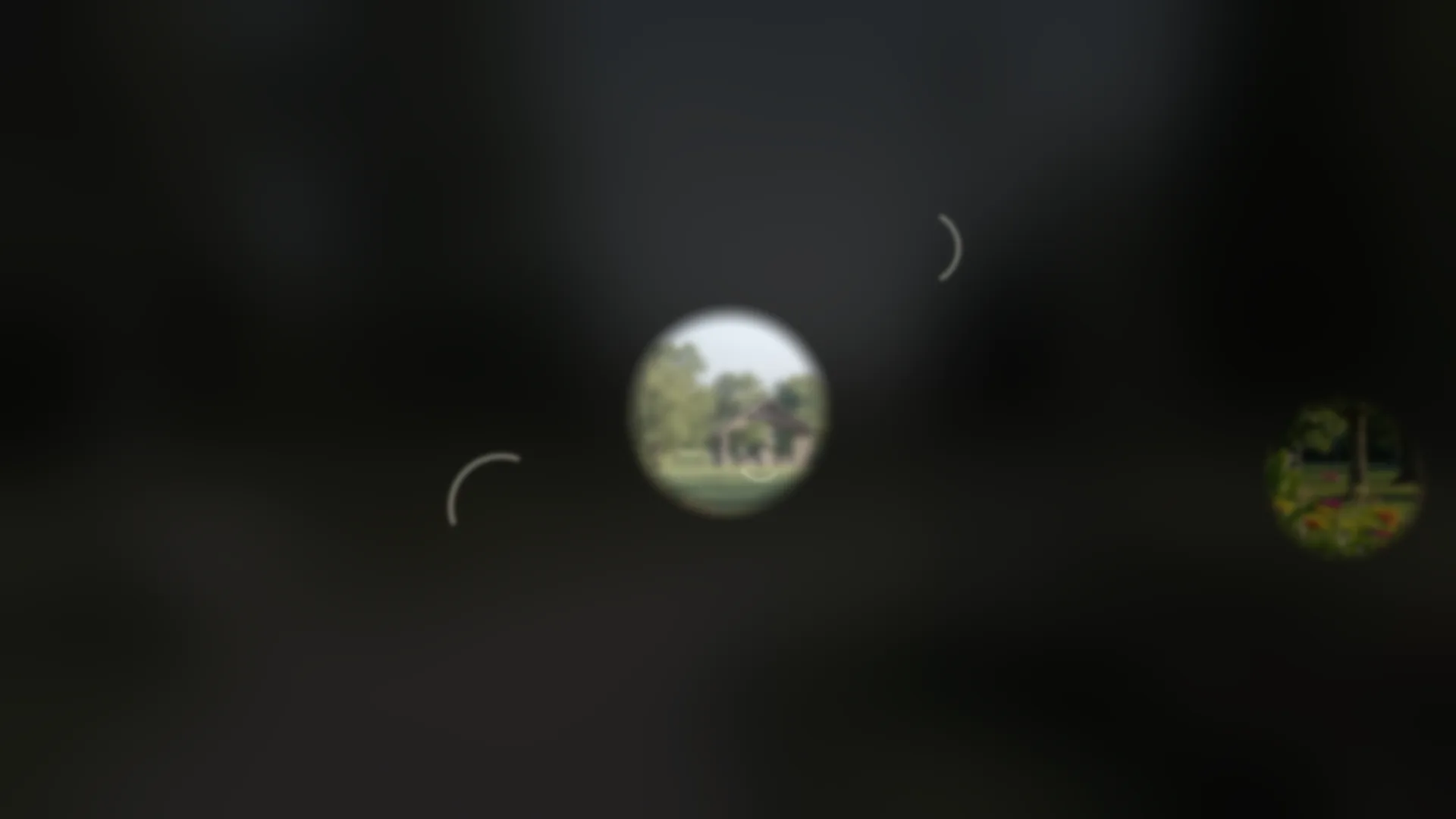
The left view never changes. The right one is the same park as retinitis pigmentosa shows it, drawn from the research our simulator rests on. Pick a stage; the caption tells you what each frame shows and what it cannot.
Mid
The ring of loss and a central island of about 26 degrees, close to Laura's description, with faint crescent-shaped flashes.
Watch retinitis pigmentosa progress
It starts with the dark, not the sides
The first symptom of RP is usually trouble adapting to the dark, and if a person does not mention it, careful questions about dusk and dimly lit places often bring out a history that goes back to childhood or the teenage years 1. Dave Steele, a poet with RP, describes it as "struggling from light to dark places" and says that in his early twenties "it was a very, very slight adjustment and one that I didn't actually at the time put down to RP. I just adjusted, took a couple of seconds and got on with things" 2.
Maggie, who has Usher syndrome type 1 (RP with deafness), puts the dusk experience this way: "The moment the sun hits the horizon, details disappear, and it feels like I've got sunglasses on anyway" 3. She also describes the paradox many people with RP live with: "light sensitivity paired with night blindness", so that on a bright day the choice is to squint or to wear sunglasses that make it too dark to see 3. Bright car headlights are a particular problem because the eyes struggle to readjust to the darkness afterwards 4.
"The moment the sun hits the horizon, details disappear, and it feels like I've got sunglasses on anyway."
Why your child does not notice the side vision going
This is the part families find hardest to believe. Side vision in RP is lost first in the mid-periphery, roughly 20 to 25 degrees out from the center, as a ring of blind spots, and this early loss "is rarely recognized by the affected individual and is usually not a presenting symptom" 1. Children with it "may be misconstrued as 'clumsy' before constriction of visual fields (i.e., 'tunnel vision') is detected" 1.
The reason is that the brain papers over the gaps. Dave Steele explains: "when you walk into a room, your brain subconsciously scans what's in the room and often it fills in the blanks for what your eyes can't see. Sometimes people who are visually impaired feel like they can see more than they actually can until they're actually physically tested" 2. He describes his own field test: "I had to hold this button and every time a light went off in my peripheral vision, I had to click the button to signify that I'd seen it. The test started and I just sat there holding the button and not clicking it" 2. Afterwards, he says, "it was almost like all of a sudden the veil came down and I started to realize that I couldn't see as much as I thought I could" 2.
So when your child says "I can see fine", they are telling the truth as they experience it. The missing pieces do not announce themselves.
"It was almost like all of a sudden the veil came down and I started to realize that I couldn't see as much as I thought I could."
What tunnel vision actually looks like
Over years the ring of blind spots widens outward and inward until a small central area remains, which is the "tunnel" people talk about 1. Laura Lawson Visconti, who writes about living with RP, has about 24 or 25 degrees of vision left compared with roughly 155 degrees for a normally sighted person: "To put it plainly, I see in tunnel vision" 5.
What is inside the tunnel is often sharp. Laura writes: "The central vision I do have left is very sharp and healthy, so unlike macular degeneration or other retinal diseases, I do not suffer from blurry vision" 5. That is why a child with RP can read a book or a phone perfectly well and still walk into a door frame. Central sharpness is usually preserved until the late stages 1.
What is outside the tunnel is the question everyone asks. Laura answers it directly: "Many people ask me if I see black in the periphery where I've experienced vision loss and the answer is that I do not; I simply do not see anything, same as the boundaries beyond a normal sighted person's range of vision" 5. Not everyone describes it the same way. Hannah, who has a cone-rod dystrophy with later side-vision loss, describes discovering that a lamp had been switched on beside her: "I realized that I had completely, it was black, it was completely black on my left side... There's nothing there" 6. Both are honest descriptions. What they share is that nothing in the lost area draws attention to itself.
In practice this means your child does not see things that appear from the side. Laura: "I do not see objects or people that unexpectedly pop up in my path, like a waiter approaching my table at a restaurant, or someone offering a handshake" 5. Rebecca Alexander, who has Usher syndrome type 3, remembers that as a teenager "I often tripped over the dogs who were below me if they were lying on the floor or coffee tables; my worst vision was right below me" 7. People with RP compensate by moving their eyes constantly. Laura again: "I scan a lot and my brain fills in the information that my eyes miss" 5.
"Many people ask me if I see black in the periphery where I've experienced vision loss and the answer is that I do not; I simply do not see anything, same as the boundaries beyond a normal sighted person's range of vision."
Flashes and sparkles
Many people with RP see lights that are not there. In one survey of 32 people with RP, 93% reported them; most described slow, drifting dots or shapes, and the commonest shape was a crescent or arc 8. Children may describe "shimmers, blinking lights, or flashes" 9. These are a known part of RP, but any new flashes should still be reported to the eye doctor 10.
What our simulation shows
Our frames follow this sequence on one park path. We deliberately did not paint the lost areas black, for the reasons above 11. There is a limit to any picture, though: a still image cannot show the brain filling in the gaps, which is the single most important thing to understand about RP.
Signs you might notice in a child
Our Children and Families guide lists early warning signs by age, from infancy through the teenage years 13.
- Being "fussy, fearful, or very hesitant at dusk", asking for more lights to be turned on, or going back to crawling after dark 12.
- Trouble seeing the ball or other players in sports, difficulty moving around in dim places such as movie theaters, and bumping into things 9.
- Tripping over low objects, pets and furniture that are just below the line of sight 7.
- Reluctance to walk in unfamiliar places, and a child who seems "clumsy" or "shy" in new environments 13.
- Seeming to see better during the day than at night, and knocking things over or tripping often 14.
Common questions
Does he see black?
Why can he read but not catch a ball?
Because RP takes side vision and dim-light vision first and leaves central sharpness until late 1. Reading uses the center; catching uses the sides.
Will glasses help?
Not for the RP itself. As Laura puts it, "people who need glasses are farsighted or nearsighted... My disease is in my retina in the back of the eye" 5.
How much vision will stay?
Go deeper
- The retinitis pigmentosa profileGenes, inheritance, what to expect, and what is in trials.
- For the clinician in the familyNot yet live. The clinician page for this condition is still in review.
- What the other conditions look like
- What does night blindness look like?
- What does Stargardt disease look like?
- What does choroideremia look like?
- What does cone dystrophy look like?
- What does achromatopsia look like?
- What does Best disease look like?
- What does Usher syndrome look like?
- What does Leber congenital amaurosis look like?
- What does vision loss look like in Bardet-Biedl syndrome?
- Children and familiesSchool, services and support, with early warning signs by age.
References
Sources were read on Oct 22-23, 2026.
- 1.GeneReviews [Internet]. Nonsyndromic Retinitis Pigmentosa Overview. University of Washington, Seattle. https://www.ncbi.nlm.nih.gov/books/NBK1417/
- 2.Hadley. Hadley Presents: The Blind Poet, Dave Steele (podcast transcript; Dave Steele describing retinitis pigmentosa). https://hadleyhelps.org/podcasts/hadley-presents/blind-poet-dave-steele
- 3.UsherKids Australia. Usher Profile Spotlight: Maggie (first-person account, Usher syndrome type 1C). https://usherkidsaustralia.com/9380-2/
- 4.O'Neal TB, Tripathy K, Luther EE. Retinitis Pigmentosa. In: StatPearls [Internet]. StatPearls Publishing; 2024. https://www.ncbi.nlm.nih.gov/books/NBK519518/
- 5.Lawson Visconti L. Going blind in a sighted world (personal blog; first-person account of retinitis pigmentosa). http://lauralawsonvisconti.com/blog/rp
- 6.Pediatric Retinal Research Foundation. Living with Cone Dystrophy: Hannah's Therapeutic Humor (podcast transcript; first-person account). https://prrf.org/living-with-cone-dystrophy/
- 7.Usher Syndrome Coalition. Meet the Usher Community: Rebecca Alexander interview (Usher syndrome type 3). https://www.usher-syndrome.org/resources/living-with-usher-syndrome/meet-the-usher-community/rebecca-alexander-interview.html
- 8.Bittner AK, Diener-West M, Dagnelie G. A survey of photopsias in self-reported retinitis pigmentosa: location of photopsias is related to disease severity. Retina. 2009;29(10):1513-1521. doi:10.1097/IAE.0b013e3181af0d57 https://pmc.ncbi.nlm.nih.gov/articles/PMC2783747/
- 9.Nemours KidsHealth. Retinitis Pigmentosa (for Parents). https://kidshealth.org/en/parents/retinitis-pigmentosa.html
- 10.Royal National Institute of Blind People (RNIB). Retinitis pigmentosa and inherited retinal dystrophies. https://www.rnib.org.uk/your-eyes/eye-conditions-az/retinitis-pigmentosa/
- 11.A Race Against Blindness. How our vision simulations were built: research basis and rendering conventions (Education Hub, Oct 2026). https://araceagainstblindness.org/education/vision-simulations/methodology
- 12.Hesperian Health Guides. Disabled Village Children: Causes of Loss of Vision. https://en.hesperian.org/hhg/Disabled_Village_Children:Causes_of_Blindness
- 13.A Race Against Blindness. Children and Families Guide: Early Warning Signs by Age. https://araceagainstblindness.org/education/children-and-families
- 14.Raising Children Network (Australia). Low vision and blindness: babies, children and teenagers. https://raisingchildren.net.au/disability/guide-to-disabilities/assessment-diagnosis/low-vision-blindness-babies-children-teens
- 15.Prevent Blindness. Retinitis Pigmentosa fact sheet (PB135). 2025. https://preventblindness.org/wp-content/uploads/2025/06/PB135-Retinitis-Pigmentosa.pdf
- 16.Gene Vision (UK). Retinitis pigmentosa: for patients. https://gene.vision/knowledge-base/retinitis-pigmentosa-for-patients/
About this page
This page is an additional resource for the community. It is not a substitute for advice from your own eye care team, or for medical journals, textbooks or clinical training. We have done our best to provide accurate and up-to-date information, and the references are listed above, but inaccuracies and omissions may exist. Confirm any medical information with your eye care team or against primary-source medical education resources before relying on it. The simulation frames are approximations built from the cited literature, not a prediction of anyone's vision.