
What does night blindness look like?
What your child sees when the lights go down. In the words of people who live with it, with the frames from our simulator and the sources behind every statement.
The short answer
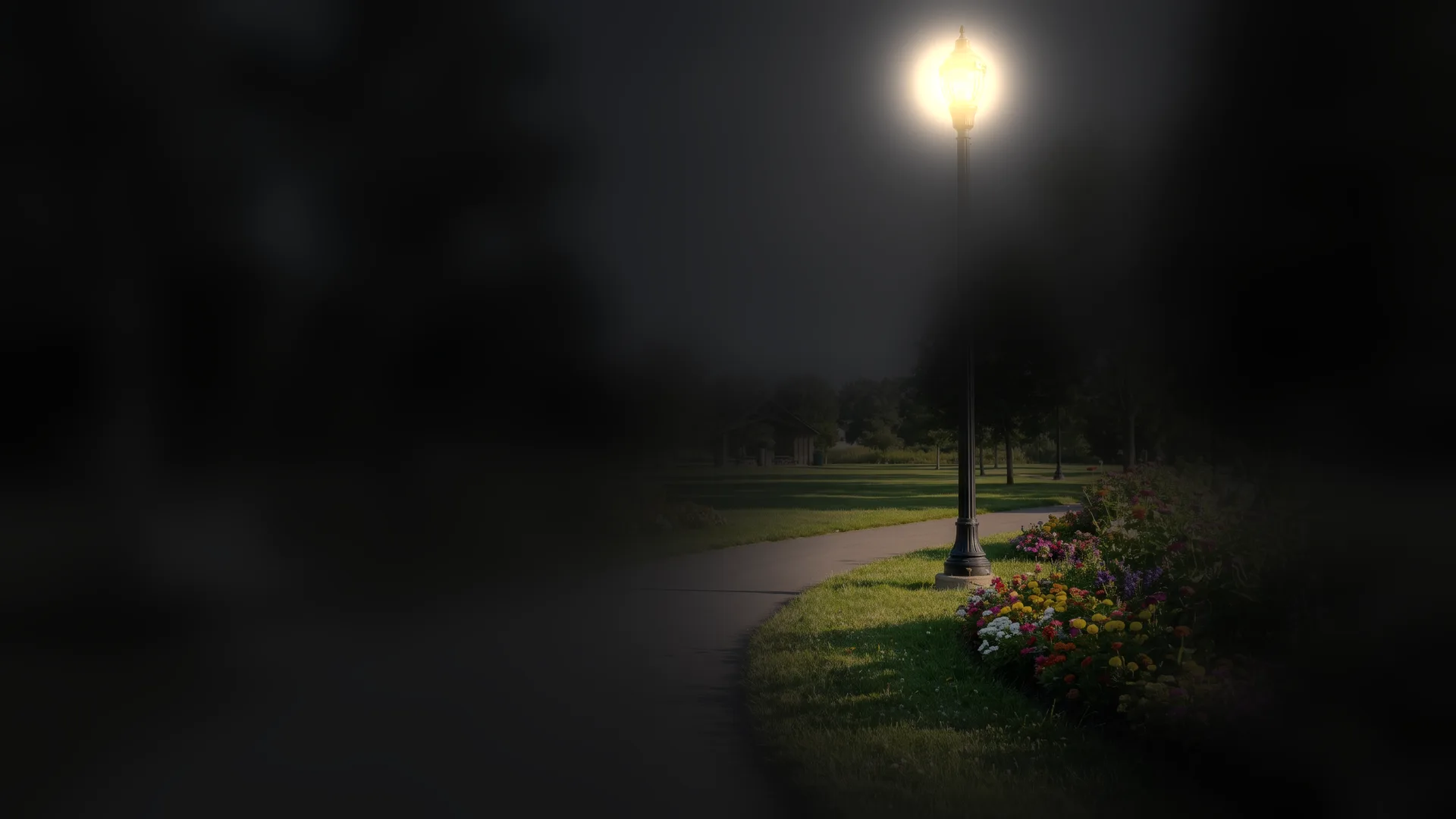
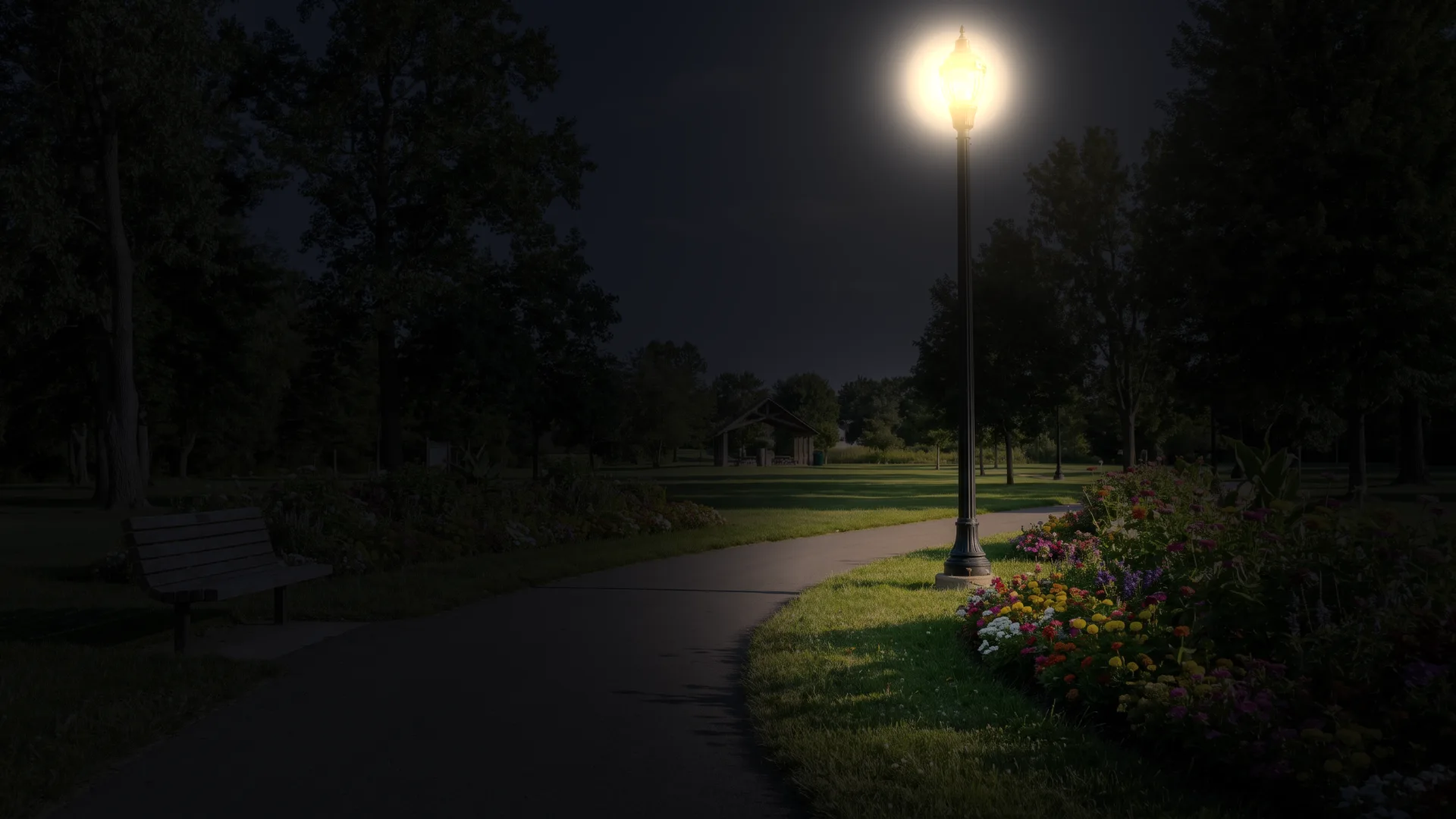
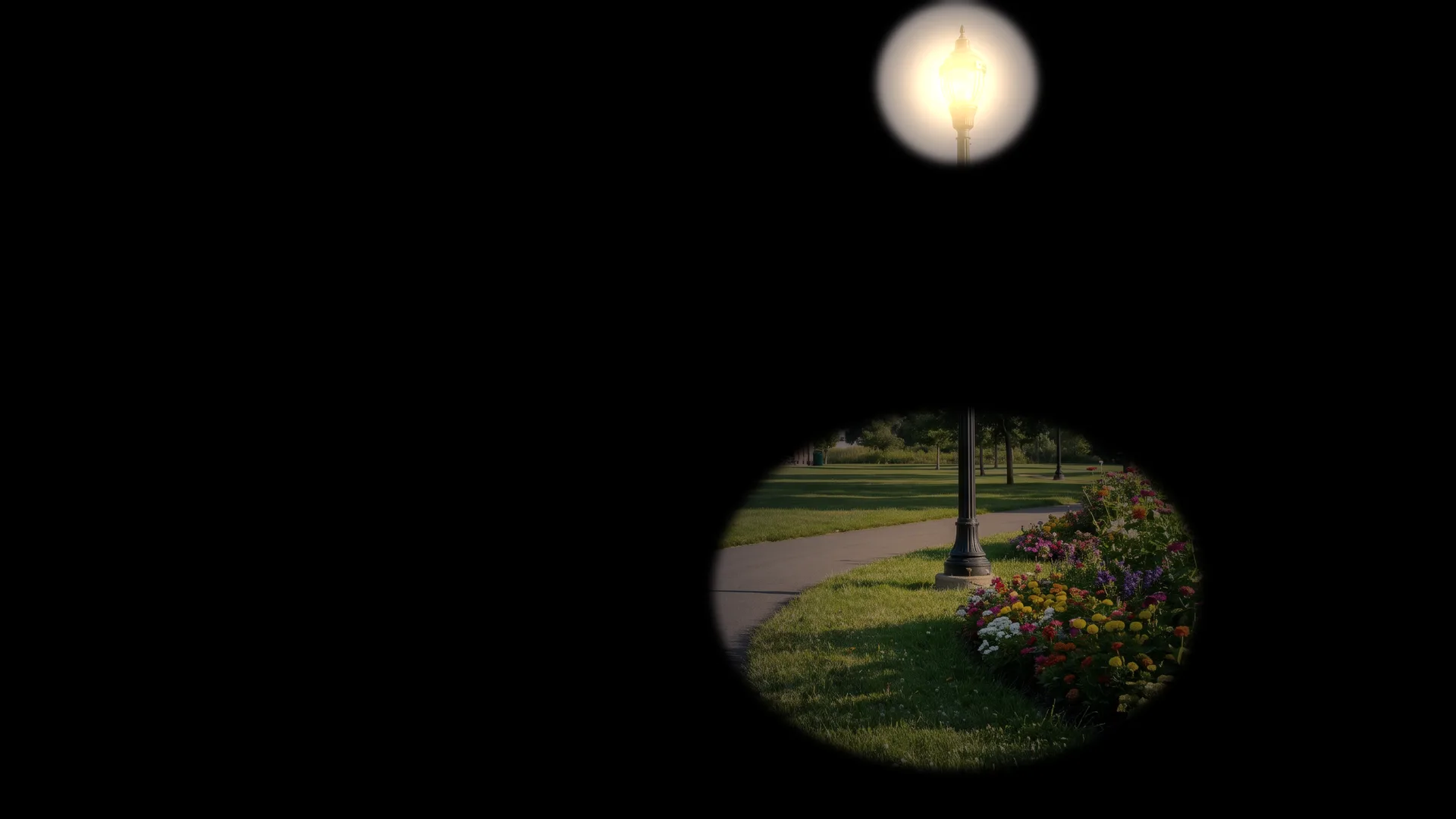
To a child with night blindness, a dim room is darker than it is for you, and it stays dark longer. Walking from a bright hallway into a dark bedroom, the few seconds you need to adjust become a long stretch in which they genuinely cannot see the floor. Outdoors, the world does not fade gently at sunset; detail drops away early, while bright lights such as headlights and the lit lamp post stand out more harshly against it. Daytime vision can be completely normal.
- What the person is experiencingNight blindness, which doctors call nyctalopia, means trouble seeing in dim or dark places.
- In their wordsAdults looking back often say the change was so gradual they explained it away.
- What it looks like in a childChildren rarely say "I have night blindness".
See it, stage by stage
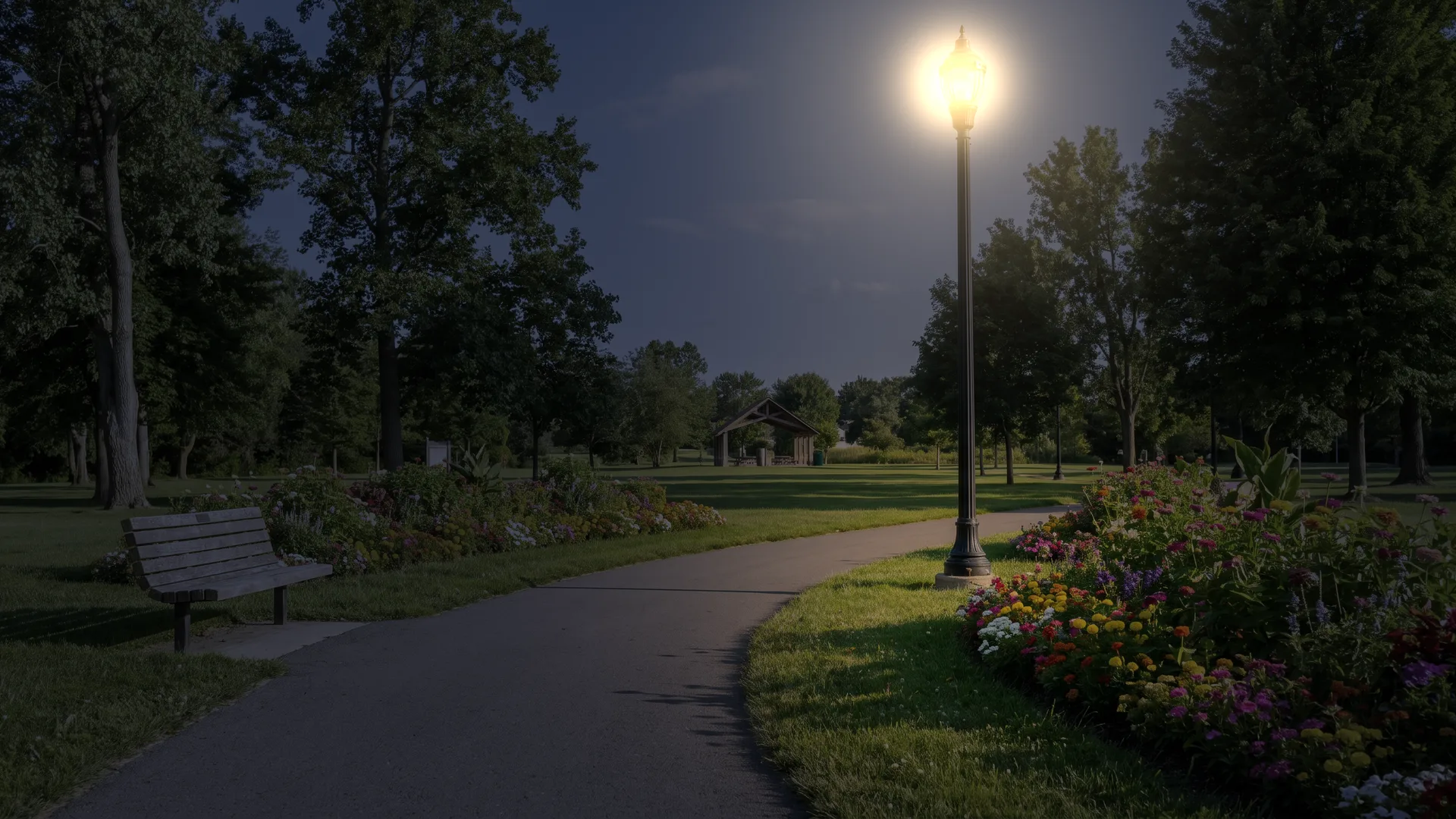
The left view never changes. The right one is the same park as night blindness shows it, drawn from the research our simulator rests on. Pick a stage; the caption tells you what each frame shows and what it cannot.
Moderate
This frame dims the whole scene and the lamp glares more against it.
What the person is experiencing
Night blindness, which doctors call nyctalopia, means trouble seeing in dim or dark places. It happens when the eyes have trouble adjusting quickly to changes in brightness, or when they struggle to detect low levels of light at all 1. It is a symptom rather than a disease, and it has many causes, from cataracts and vitamin A shortage to inherited retinal conditions such as retinitis pigmentosa 1.
In the inherited conditions the cause is the rods, the retinal cells that do the seeing in dim light and at the edges of vision 2. When rods fail first, the earliest thing a person notices is difficulty in dim rooms and at night, and difficulty adjusting when going from bright to dark 2. Oncoming headlights are a classic problem because the eyes cannot readjust to the dark road afterwards 3.
In their words
Adults looking back often say the change was so gradual they explained it away. Dave Steele, who has RP, says of his twenties: "that struggling from light to dark places but it was a very, very slight adjustment... I just adjusted, took a couple of seconds and got on with things" 4. Doctors know this: if a patient does not volunteer it, "detailed questioning about activities at dusk or with minimal lighting often elicits such a history starting in childhood or adolescence" 5.
Maggie, who has Usher syndrome type 1, describes sunset as a switch rather than a dimmer: "The moment the sun hits the horizon, details disappear, and it feels like I've got sunglasses on anyway" 6. Helene Lonborg-Moller, a physician with Usher syndrome type 2, dates her first clue to a scooter accident "as streetlights were turned off at midnight", and later to missing a ferry "because of having to drive slow at night" 7. Twilight driving is particularly hard because the eyes are juggling a darkening landscape against a still-bright sky 1.
"The moment the sun hits the horizon, details disappear, and it feels like I've got sunglasses on anyway."
What it looks like in a child
Children rarely say "I have night blindness". They show it. A child may be "fussy, fearful, or very hesitant at dusk, may ask for more lights to be turned on, or may revert to crawling after dark" 8. They may find it hard to move around in low-light places such as movie theaters, and bump into things 9. They may seem to see better during the day than at night 10. Our Children and Families guide lists "bumping into objects, especially in dim light" and "reluctance to walk in unfamiliar environments" among toddler signs, and "night blindness (fear of dark, tripping at dusk)" among school-age signs 11. A sudden fear of the dark in a child who was not afraid before is worth mentioning to an eye doctor.
What our simulation shows
Our frames use the same park path at dusk. These are our best reading of patient descriptions; the sources describe the difficulty rather than a precise picture, so the exact darkness and glare are judgment calls 12.
Common questions
Is it the first sign of something serious?
Does my child see nothing at night?
Go deeper
- For the clinician in the familyNot yet live. The clinician page for this condition is still in review.
- What the other conditions look like
- What does retinitis pigmentosa look like?
- What does Stargardt disease look like?
- What does choroideremia look like?
- What does cone dystrophy look like?
- What does achromatopsia look like?
- What does Best disease look like?
- What does Usher syndrome look like?
- What does Leber congenital amaurosis look like?
- What does vision loss look like in Bardet-Biedl syndrome?
- Children and familiesSchool, services and support, with early warning signs by age.
References
Sources were read on Oct 22-23, 2026.
- 1.Cleveland Clinic. Night blindness (nyctalopia). https://my.clevelandclinic.org/health/symptoms/10118-night-blindness-nyctalopia
- 2.Gene Vision (UK). Retinitis pigmentosa: for patients. https://gene.vision/knowledge-base/retinitis-pigmentosa-for-patients/
- 3.O'Neal TB, Tripathy K, Luther EE. Retinitis Pigmentosa. In: StatPearls [Internet]. StatPearls Publishing; 2024. https://www.ncbi.nlm.nih.gov/books/NBK519518/
- 4.Hadley. Hadley Presents: The Blind Poet, Dave Steele (podcast transcript; Dave Steele describing retinitis pigmentosa). https://hadleyhelps.org/podcasts/hadley-presents/blind-poet-dave-steele
- 5.GeneReviews [Internet]. Nonsyndromic Retinitis Pigmentosa Overview. University of Washington, Seattle. https://www.ncbi.nlm.nih.gov/books/NBK1417/
- 6.UsherKids Australia. Usher Profile Spotlight: Maggie (first-person account, Usher syndrome type 1C). https://usherkidsaustralia.com/9380-2/
- 7.Living with Usher Syndrome: Patient and Physician Perspectives (commentary co-authored by patient Helene Lonborg-Moller with ophthalmologists Yousif Subhi and Line Kessel). 2020. PMC7406578. https://pmc.ncbi.nlm.nih.gov/articles/PMC7406578/
- 8.Hesperian Health Guides. Disabled Village Children: Causes of Loss of Vision. https://en.hesperian.org/hhg/Disabled_Village_Children:Causes_of_Blindness
- 9.Nemours KidsHealth. Retinitis Pigmentosa (for Parents). https://kidshealth.org/en/parents/retinitis-pigmentosa.html
- 10.Raising Children Network (Australia). Low vision and blindness: babies, children and teenagers. https://raisingchildren.net.au/disability/guide-to-disabilities/assessment-diagnosis/low-vision-blindness-babies-children-teens
- 11.A Race Against Blindness. Children and Families Guide: Early Warning Signs by Age. https://araceagainstblindness.org/education/children-and-families
- 12.A Race Against Blindness. How our vision simulations were built: research basis and rendering conventions (Education Hub, Oct 2026). https://araceagainstblindness.org/education/vision-simulations/methodology
- 13.Choroideremia Research Foundation (CureCHM). Symptoms and Progression. https://curechm.org/symptoms-progression/
About this page
This page is an additional resource for the community. It is not a substitute for advice from your own eye care team, or for medical journals, textbooks or clinical training. We have done our best to provide accurate and up-to-date information, and the references are listed above, but inaccuracies and omissions may exist. Confirm any medical information with your eye care team or against primary-source medical education resources before relying on it. The simulation frames are approximations built from the cited literature, not a prediction of anyone's vision.